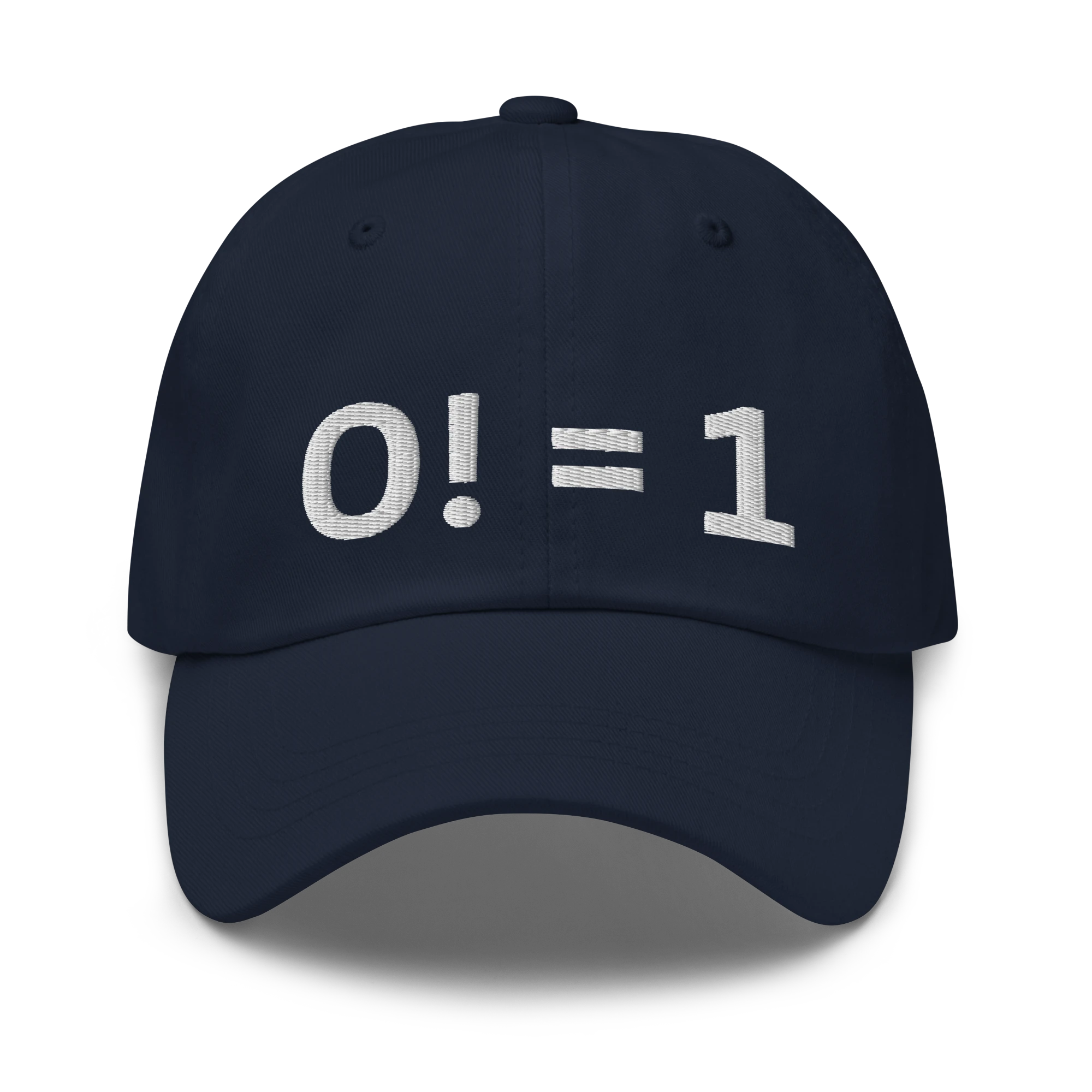
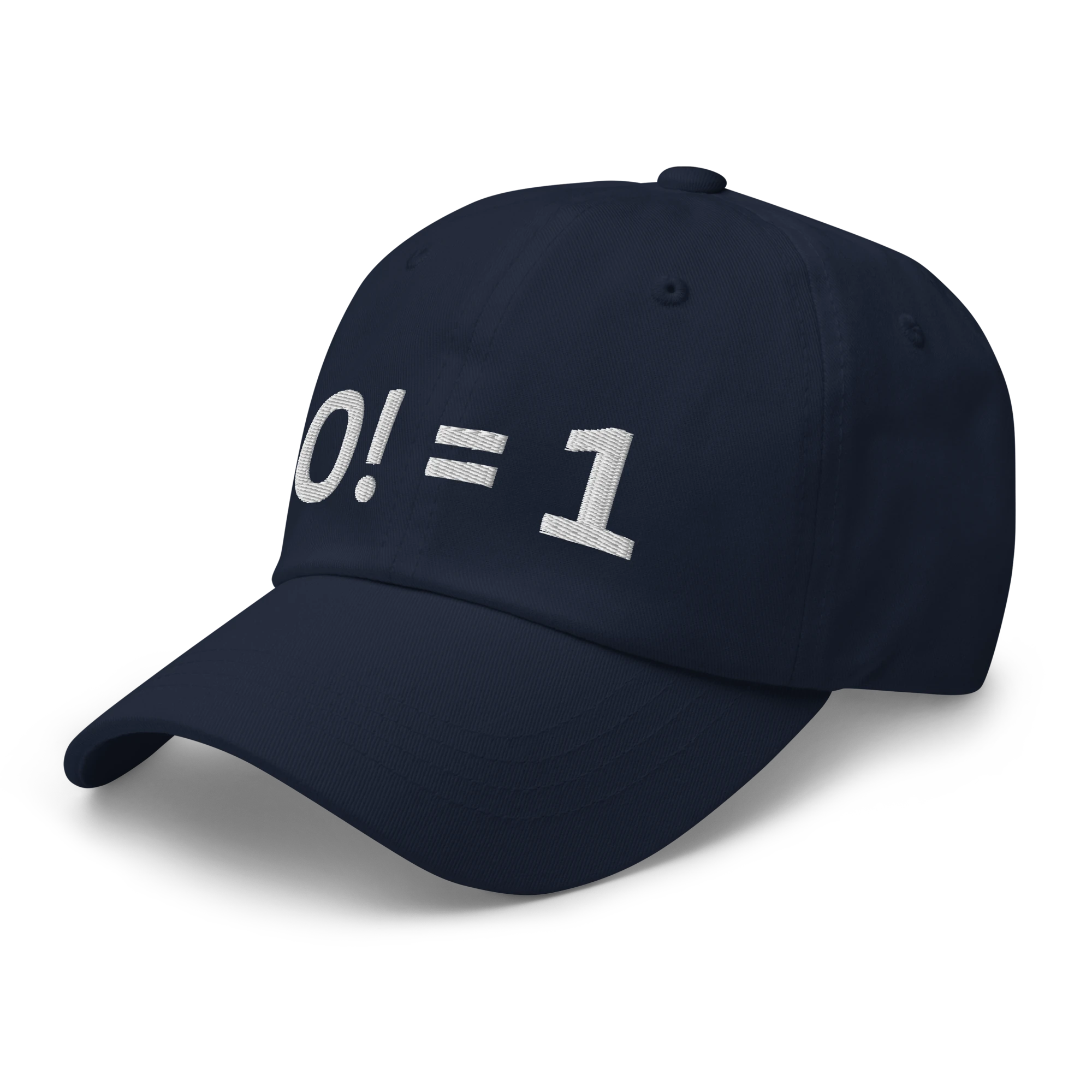
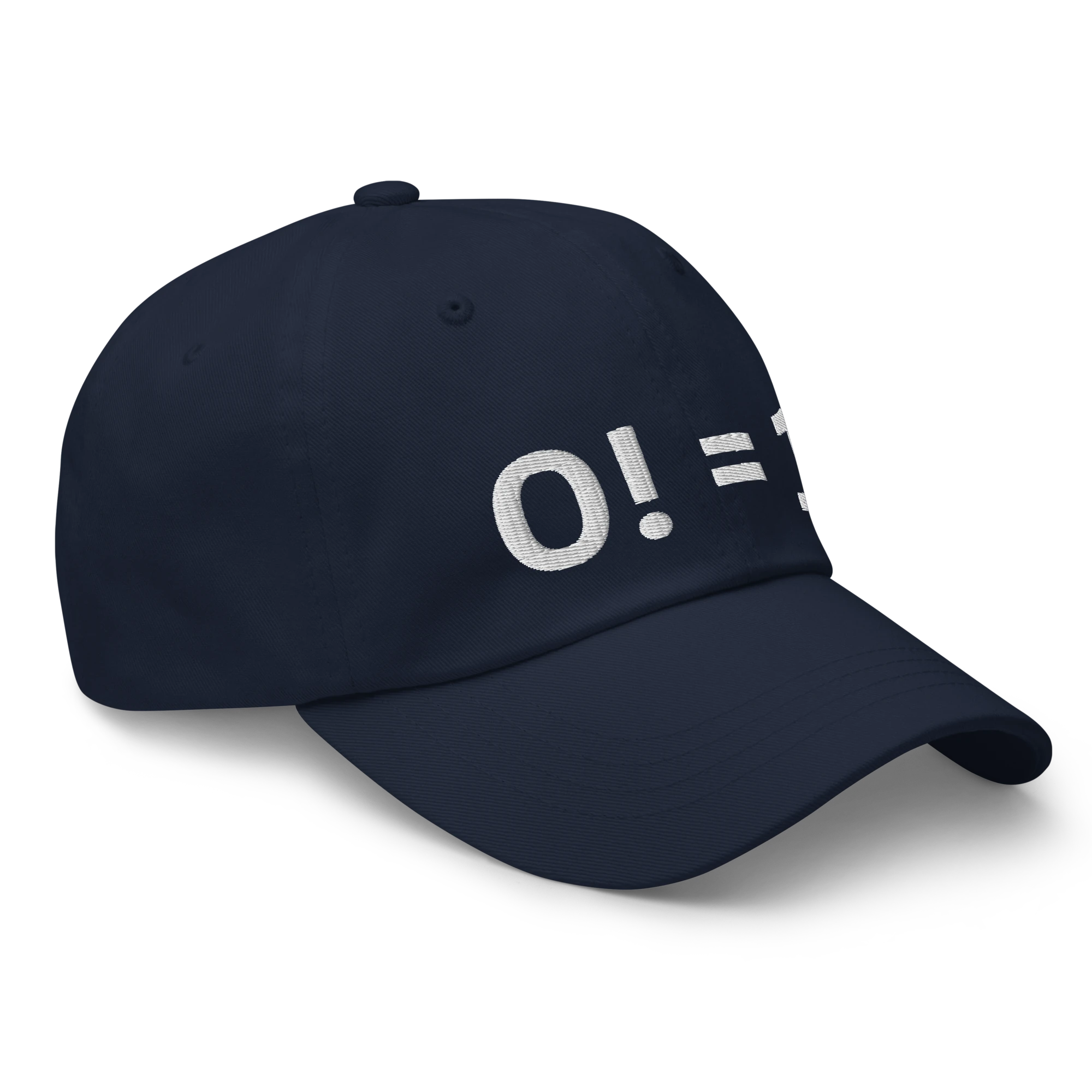
Start with factorials
For a positive integer n, n! is the product of all positive integers from n down to 1. So 5! = 5 × 4 × 3 × 2 × 1 = 120. Factorials count permutations: the number of ways to arrange n distinct objects is n!.
How many ways can you arrange nothing?
There is exactly one arrangement of zero objects: the empty arrangement. In combinatorics, that is not a joke. Counting problems need a well-defined empty case, and assigning 0! = 1 makes formulas work consistently when a selected set contains nothing.
The recurrence forces the same answer
Factorials satisfy n! = n × (n−1)!. Set n = 1: 1! = 1 × 0!. Since 1! = 1, the equation requires 0! = 1. The empty-product convention says the same thing: a product with no factors has multiplicative identity 1, just as a sum with no terms has additive identity 0.
Why wear it?
Because it is one of mathematics’ best tiny surprises. The statement looks wrong long enough to make someone ask why, and the explanation rewards the question. Three characters, one equality, an entire lesson about edge cases.
Wear what you know.
You are not wearing a random graphic. You are wearing something you know, understand, believe, study, build, play, or find worth thinking about. That is the idea behind every NerdWear Expression.